

As part of my second module in Equine Assisted Therapy, I’m conducting a case study exploring how interaction with the equine and its environment can support movement control, postural awareness, and wellbeing in adults with chronic pain and hyper-mobility related issues.
For this project, I’m working with one of my lovely friends — who I’ll refer to here as “C”. She has kindly agreed to share aspects of her journey as part of my study, and her openness has made this process both rewarding and deeply insightful.
Why “C” Was the Perfect Fit
“C” lives with chronic low back pain and joint hyper-mobility, which together influence her movement efficiency, body awareness, and confidence. Like many people managing long-term conditions, she experiences variability in muscle tone, stability, and fatigue — factors that often create a sense of disconnection between body and movement.
She also has a background with horses, which brings an extra layer of familiarity and emotional resonance to this work. This shared language of movement and trust between horse and human provides the perfect foundation for exploring how hippotherapy principles can be applied through ground-based and mounted interactions.
When selecting a participant, I wanted to work with someone who could benefit from exploring:
• How rhythmic equine movement and environmental engagement can enhance proprioception and postural control
• The impact of presence, observation, and co-regulation with the horse on nervous system regulation
• How sensory and emotional feedback from the equine and environment might influence pain perception and movement confidence
“C” embodies all of these qualities — bringing curiosity, openness, and courage to every session. Her willingness to tune into subtle movement cues, both in herself and in the horse, is already revealing valuable insights into how hippotherapy-based approaches can support people living with hyper-mobility and persistent low back pain.
Another key consideration in any hippotherapy session is the team required to ensure safety and therapeutic effectiveness. While “C” is a competent rider, hippotherapy involves a different dynamic — one where the client is a passive participant, allowing the horse’s movement to guide and influence their body. This requires a skilled leader to manage the horse and a side walker to support and monitor the rider. Sessions are typically conducted using a bareback pad, which maintains close contact with the horse’s movement while providing comfort and reducing the risk of slipping. A well-trained team is essential to create an environment of safety, confidence, and trust, allowing the therapeutic process to unfold smoothly. I was incredibly fortunate that “C’s” mum — an experienced RDA volunteer — led beautifully, while her son stepped into the side walker role with enthusiasm and care. A huge thank you to them both for their calm professionalism and teamwork.
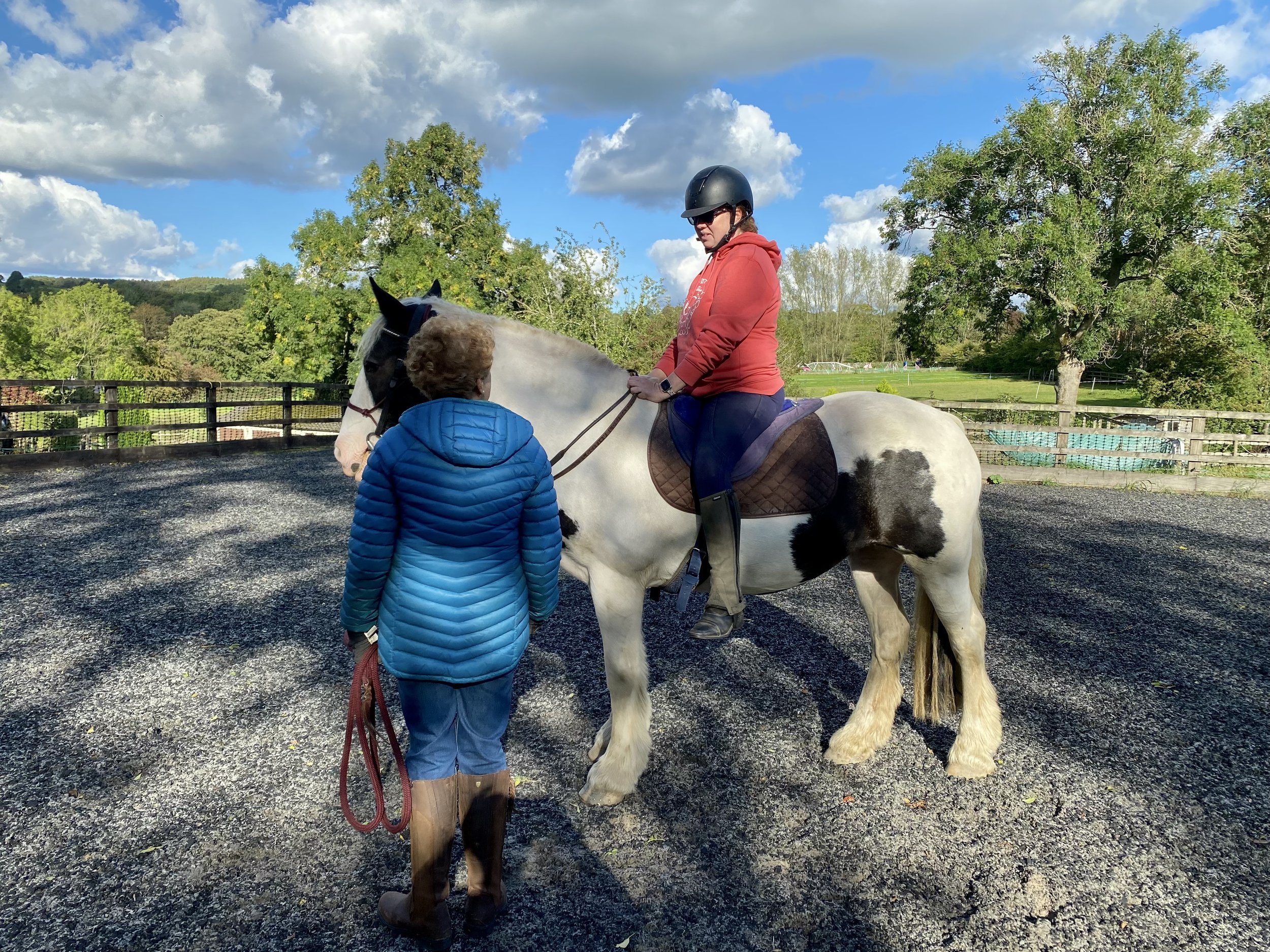
Taking a short break… we didn’t have a photographer so had to make do with photos in between sessions…
Our sessions to date have included a combination of arena-based movement and on-board exercises designed to enhance “C’s” pelvic mobility, symmetry, and lower back freedom. We focused on improving pelvic alignment and control, using specific school movements to target areas of restriction. Initially, “C” tended towards an anterior pelvic tilt with lower back bracing, and limited pelvic motion to the right. Within just two sessions, she developed noticeably better release into posterior pelvic tilt, reduced bracing, and far more symmetrical pelvic movement. Most importantly, she reported significantly less pain when riding — and even noticed reduced discomfort when walking uphill. Her main goal, to ride downhill without pain, was achieved after the second session — a fantastic milestone in her progress.
For our first two sessions, “C” worked with her own 14.2hh Gypsy Cob mare, “P” — a kind, willing partner with her own unique movement patterns and asymmetries. While “P” has offered a wonderful starting point for reintroducing movement and confidence under saddle, her natural imbalances may also have influenced some of the asymmetry observed in “C’s” posture and pelvic motion. To explore this further, our next session will take place with my 14.2hh Connemara mare, “L”. As I know “L” inside out — and with her being highly trained in academic groundwork and work in hand — she will provide a more controlled and insightful picture of how the horse’s movement influences the rider’s body. This change will also allow us to introduce more lateral work, offering a richer opportunity to observe and guide the interplay between equine movement and rider alignment. I’m genuinely excited to see how this next phase deepens both “C’s” progress and my understanding of the subtle dialogue between horse and human.
“C’s” progress highlights just how powerful hippotherapy can be for riders managing chronic pain, hyper-mobility, or movement asymmetry. The rhythmic, multidimensional motion of the horse offers a unique opportunity for the nervous system to relearn balance, control, and confidence in movement — in a way that traditional clinic-based physiotherapy often can’t replicate. Each session becomes a dialogue between rider and horse, where awareness grows, tension releases, and movement begins to feel fluid again.
Every session also reminds me that equine-assisted therapy is a true partnership — between rider, therapist, and horse. Every movement, breath, and moment of connection offers new information and new potential for change. Working with both “P” and “L” will deepen my understanding of the horse’s influence on the rider and reveal how adaptable and responsive this process can be when guided with curiosity, compassion, and evidence-informed practice. It’s a journey of shared learning — one that continues to reshape how I view physiotherapy, movement, and the profound intelligence of the horse–human connection. I can’t wait to see where it leads to next.